
Laser heating
Bring controlled optical heating into TEM experiments where thermal response and local structure need to be studied together.
TEM optical accessory
Add light or local laser heating to selected TEM studies, including photothermal response, sample stimulation, and photon-stimulated EELS/EEGS examples.
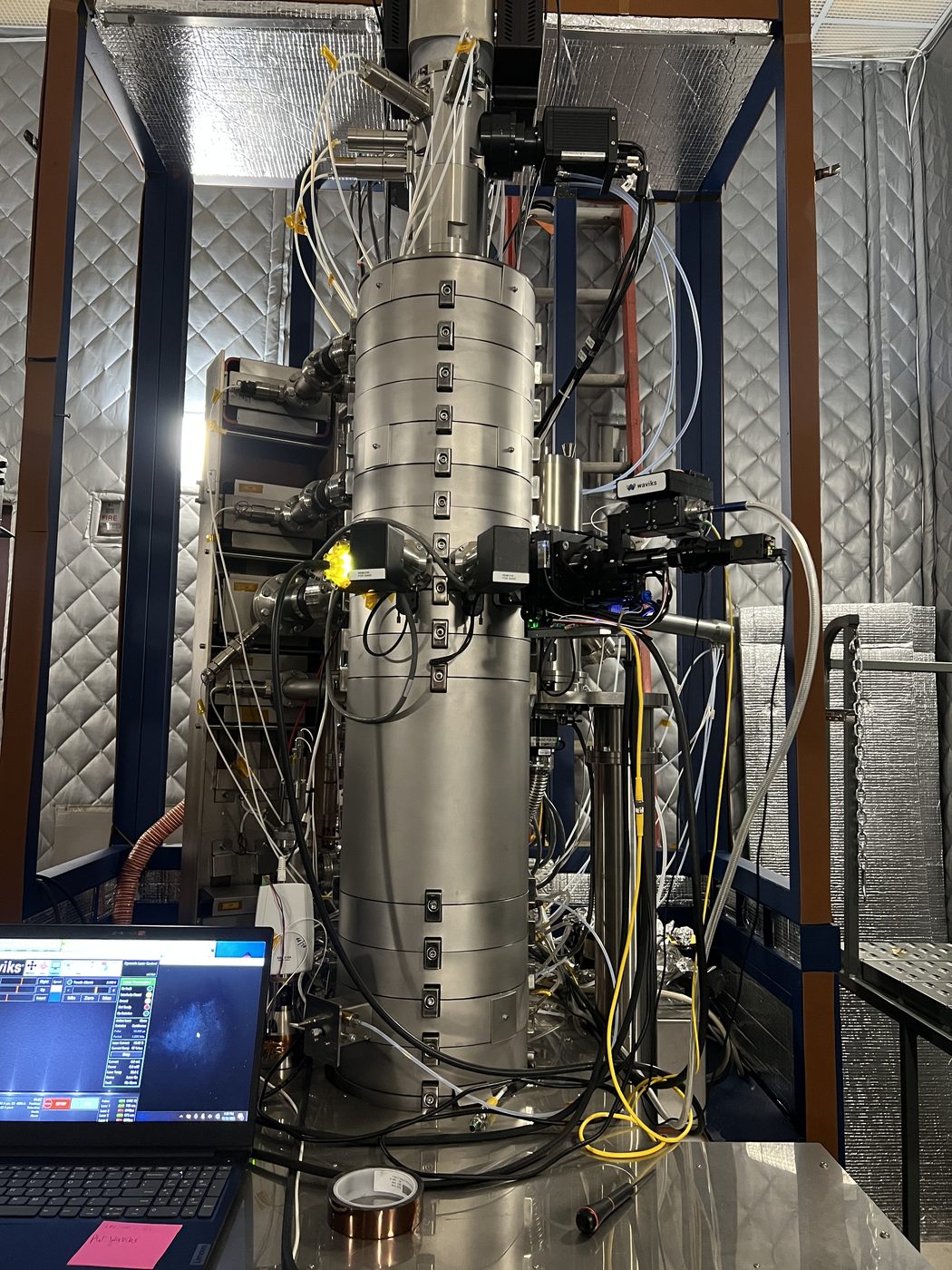
Accessory overview
Vesta for TEM adds optical excitation, local laser heating, optical access, and Aether control to TEM studies where the instrument geometry supports it. Publication-backed examples include photothermal TEM, photon-stimulated EELS/EEGS, laser-enabled synthesis, and sample stimulation.
Waviks reviews the microscope, holder strategy, optical path, sample environment, and experiment goals before recommending a Vesta TEM approach.
Capabilities
Vesta for TEM is reviewed around the target instrument, holder environment, optical access, and experiment requirements.
Bring controlled optical heating into TEM experiments where thermal response and local structure need to be studied together.
Support photon-based excitation paths where the microscope geometry, holder design, and optical access allow it.
Coordinate optical stimulation or signal pathways with electron microscopy observations for richer experiment context.
Enable experiments that combine electron imaging with light, heat, or other controlled sample interactions.
Study phase evolution, defect behavior, and material response under controlled optical heating.
Use Aether to coordinate hardware profiles, optical alignment, laser control, motion, and experiment setup.
Publication examples
Selected publication examples support optical heating, photon-stimulated spectroscopy, laser-enabled synthesis, and correlated TEM observation.
Vesta TEM work studying recrystallization, grain growth, phase separation, and dewetting in thin films.
10.1017/S1431927618015465Optical excitation linked with electron energy gain/loss in plasmonic nanoparticles.
10.1021/acsphotonics.9b00830TEM observation of laser-induced synthesis and photonic nanostructure behavior.
10.1117/12.2578719Applications
Vesta for TEM is aimed at experiments where controlled optical or heating workflows can reveal material behavior inside the TEM environment.
Study radiation-relevant materials and thermal response with correlated TEM observations.
Explore temperature-dependent structure, defects, and phase behavior in advanced oxide systems.
Investigate phase change, heating response, and structural evolution in energy materials.
Follow structural evolution as materials respond to heat, light, or controlled stimulation.
Connect local stimulation and temperature-dependent behavior to defect motion and microstructure.
Plan workflows where dose, heat, and optical stimulation need careful experimental control.
Tell us your TEM model, holder approach, optical access constraints, sample environment, and measurement goals. Waviks can review whether a Vesta TEM approach is practical.